Buy Tickets
| Time Limit: 4000MS | Memory Limit: 65536K | |
| Total Submissions: 18673 | Accepted: 9275 |
Description
Railway tickets were difficult to buy around the Lunar New Year in China, so we must get up early and join a long queue…
The Lunar New Year was approaching, but unluckily the Little Cat still had schedules going here and there. Now, he had to travel by train to Mianyang, Sichuan Province for the winter camp selection of the national team of Olympiad in Informatics.
It was one o’clock a.m. and dark outside. Chill wind from the northwest did not scare off the people in the queue. The cold night gave the Little Cat a shiver. Why not find a problem to think about? That was none the less better than freezing to death!
People kept jumping the queue. Since it was too dark around, such moves would not be discovered even by the people adjacent to the queue-jumpers. “If every person in the queue is assigned an integral value and all the information about those who have jumped the queue and where they stand after queue-jumping is given, can I find out the final order of people in the queue?” Thought the Little Cat.
The Lunar New Year was approaching, but unluckily the Little Cat still had schedules going here and there. Now, he had to travel by train to Mianyang, Sichuan Province for the winter camp selection of the national team of Olympiad in Informatics.
It was one o’clock a.m. and dark outside. Chill wind from the northwest did not scare off the people in the queue. The cold night gave the Little Cat a shiver. Why not find a problem to think about? That was none the less better than freezing to death!
People kept jumping the queue. Since it was too dark around, such moves would not be discovered even by the people adjacent to the queue-jumpers. “If every person in the queue is assigned an integral value and all the information about those who have jumped the queue and where they stand after queue-jumping is given, can I find out the final order of people in the queue?” Thought the Little Cat.
Input
There will be several test cases in the input. Each test case consists of N + 1 lines where N (1 ≤ N ≤ 200,000) is given in the first line of the test case. The next N lines contain the pairs of values Posi and Vali in the increasing order of i (1 ≤ i ≤ N). For each i, the ranges and meanings of Posi and Vali are as follows:
- Posi ∈ [0, i − 1] — The i-th person came to the queue and stood right behind the Posi-th person in the queue. The booking office was considered the 0th person and the person at the front of the queue was considered the first person in the queue.
- Vali ∈ [0, 32767] — The i-th person was assigned the value Vali.
There no blank lines between test cases. Proceed to the end of input.
Output
For each test cases, output a single line of space-separated integers which are the values of people in the order they stand in the queue.
Sample Input
4
0 77
1 51
1 33
2 69
4
0 20523
1 19243
1 3890
0 31492
Sample Output
77 33 69 51
31492 20523 3890 19243
Hint
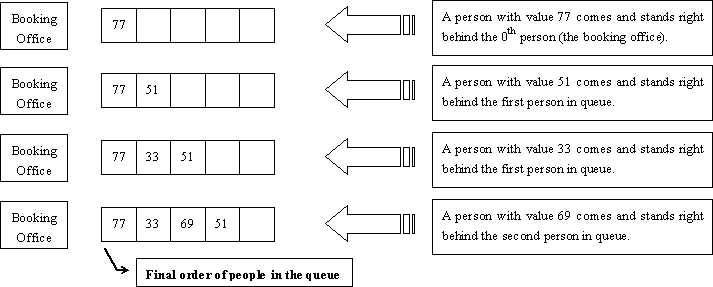
The figure below shows how the Little Cat found out the final order of people in the queue described in the first test case of the sample input.

Source
POJ Monthly–2006.05.28, Zhu, Zeyuan
题解
多组测试数据。
每组测试数据第一行包含一个整数N (1 ≤ N ≤ 200,000),接下来N行每行为一个数对(Posi,Vali),其中0 ≤ Posi ≤ i-1,0 ≤ Vali ≤ 32767,Posi表示当第i个人插入到队伍中时,有多少人在他前面,Vali表示第i个人的编号。
对于每组测试数据输出一行,包含N个人的编号,表示队伍最后长什么样。
我们发现,先进来的人不会对后进的人产生影响,所以要倒叙处理。对于整个题目来说,我们发现,它只是对[1, n]这个区间进行修改,所以很自然的想到线段树。首先,我们用一个结构体来储存当前这个节点左右节点还剩下多少空位,然后一个一个的根据它前面还有多少人来确定要把它往哪里扔(即p数组里面存的)。
#include<iostream>
#include<cstdio>
#include<cstring>
#include<algorithm>
using namespace std;
int p[233333], v[233333], dl[233333];
struct orz
{
	int l, r, sum;
}a[233333 * 4];
void build(int x, int l, int r)
{
	a[x].l = l;
	a[x].r = r;
	a[x].sum = (r - l + 1);
	if(l == r)
		return ;
	int mid = (l + r) / 2;
	build(x*2, l, mid);
	build(x*2+1, mid+1, r);
}
void deal(int x, int p, int v)
{
	int l = a[x].l;
	int r = a[x].r;
	int mid = (l+r) / 2;
	if(l == r)
	{
		a[x].sum = 0;
		dl[l] = v;
		return ;
	}
	if(a[x*2].sum >= p) deal(x*2, p, v);
	else	deal(x*2+1, p - a[x*2].sum, v);
	a[x].sum = a[x*2].sum + a[x*2+1].sum;
}
int main()
{
	int n;
	while(cin>>n)
	{
		build(1, 1, n);
		for(int i = 1;i <= n;i ++)
		{
			scanf("%d%d", &p[i], &v[i]);
		}
		for(int i = n;i >= 1;i --)
		{
			deal(1, p[i]+1, v[i]);
		}
		for(int i = 1;i < n;i ++)
			printf("%d ", dl[i]);
		cout<<dl[n]<<endl;
	}
	return 0;
}